Best Legal Steroids
CDX Biotech is your go-to supplier for 100% genuine steroids products, all compound are strictly produced as per cGMP guideline, 100% quality can be guaranteed.


| Types of Testosterone powders | CAS No. |
| Testosterone Enanthate Powder | 315-37-7 |
| Testosterone Cypionate Powder | 58-20-8 |
| Testosterone propionate Powder | 57-85-2 |
| Sustanon 250 Powder | / |
| Testosterone isocaproate Powder | 15262-86-9 |
| Testosterone phenylpropionate Powder | 1255-49-8 |
| Testosterone acetate Powder | 1045-69-8 |
| Testosterone Base Powder | 58-22-0 |
| Testosterone decanoate Powder | 5721-91-5 |
| Testosterone undecanoate Powder | 5949-44-0 |
| Oral turinabol (4-Chlorodehydromethyltestosterone) Powder | 2446-23-3 |
| Methyltestosterone (17-methyltestosterone) Powder | 58-18-4 |
| Methyl-1-Testosterone Powder | 65-04-3 |
| Fluoxymesterone (Halotestin) Powder | 76-43-7 |
| 1-Testosterone Cypionate Powder | / |
| 1-Testosterone Powder | 65-06-5 |
| Mesterolone (Proviron) Powder | 1424-00-6 |
| Clostebol Acetate Powder | 855-19-6 |
All Testosterone Powders are produced in strict accordance with cGMP guidelines, 100% quality assurance, with purity no less than 98%.
| Category | Items | Concentration |
| Testosterone Injections | Testosterone Enanthate | 250mg/ml, 300mg/ml |
| Testosterone Propionate | 100mg/ml, 200mg/ml | |
| Testosterone Cypionate | 250mg/ml | |
| Testosterone Suspension | 100mg/ml | |
| Testosterone Acetate | 100mg/ml | |
| Testosterone Decanoate | 250mg/ml | |
| Testosterone Undecanoate | 250mg/ml | |
| Methyltestosterone | 25mg/ml |
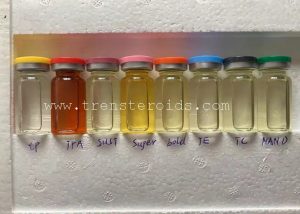
All Testosterone injections are produced in the sterile laboratory, and the raw materials used meet USP standards, both retail and wholesale orders are available.
| Category | Items | Active ingredients | Content per ml |
| Testosterone Blend | Sustanon 250 | Testosterone Propionate | 30 mg |
| Testosterone Phenylpropionate | 60 mg | ||
| Testosterone Isocaproate | 60 mg | ||
| Testosterone Decanoate | 100 mg | ||
| Testosterone mix 325 | Testosterone Propionate | 65mg | |
| Testosterone Phenylpropionate | 65mg | ||
| Testosterone Cypionate | 85mg | ||
| Testosterone Decanoate | 110mg | ||
| Tri Test 400 | Testosterone Enanthate | 120mg | |
| Testosterone Cypionate | 120mg | ||
| Testosterone Decanoate | 160mg | ||
| Supertest 450 | Testosterone Acetate | 32mg | |
| Testosterone Decanoate | 147mg | ||
| Testosterone Phenylpropionate | 73mg | ||
| Testosterone Propionate | 73mg | ||
| Testosterone Cypionate | 125mg | ||
| Test Blend-450 | Testosterone Propionate | 30mg | |
| Testosterone Phenylpropionate | 60mg | ||
| Testosterone Isocaproate | 60mg | ||
| Testosterone Decanoate | 100mg | ||
| Testosterone Enanthate | 100mg | ||
| Testosterone Cypionate | 100mg | ||
Testosterone is an androgen that is primarily produced by the testes in cells called Leydig cells. Testosterone is the hormone responsible for the development of male sexual characteristics. Hormones are chemical messengers that trigger necessary changes in the body. Women also produce testosterone, usually in smaller amounts.
In men, testosterone is thought to regulate many functions along with sperm production. These include: muscle size and strength, bone mass, libido, fat distribution, red blood cell production. Without adequate amounts of testosterone, men can become infertile. This is because testosterone helps in the development of mature sperm.
Testosterone can enter cells passively and bind to androgen receptors that act directly upon the nucleus of a cell. It can also serve as a prohormone in sex glands and tissues such as your skin, hair follicles, and fat. In fat tissue, the aromatase enzyme converts testosterone to the estrogen, estradiol. Testosterone acts directly upon a tissue, but also as a prohormone by being converted to its androgen or estrogen metabolite. In adults, testosterone has effects across the body:
• Body Fat: Blocks the uptake of fat and storage of fat, and increases the number of fat burning beta-adrenergic receptors.
• Muscles: Increases protein synthesis, and increases muscle mass and strength.
• Heart: Increases blood flow and cardiac output.
• Male Sex Organs: Supports sperm production and viability, and promotes penis growth and erectile function.
• Brain: Improves cognition, memory, sex drive, and affects feelings.
• Bone: Increases red blood cell production and bone growth, and maintains bone density.
• Kidneys: Produces erythropoietin (EPO), which stimulates red blood cell production.
• Skin: Supports collagen production and produces hair.
• In addition, testosterone increases insulin-like growth factor (IGF-1), and healthy testosterone levels are associated with good health and immune function, lower mortality, lower body fat, and increased metabolic rate
In men with low testosterone, supplementing with the hormone has likewise been shown to improve muscle mass, energy, sexual performance, libido and bone mineral density, and reduce body fat, depression, and problems within the urinary tract.
There is also research showing that once-daily use of a medical testosterone transdermal gel in patients with fibromyalgia can be effective in treating chronic pain.
Symptoms of low testosterone depend on the age of person, and include: Loss of muscular strength, Depressed mood, Low sex drive, Decreased sense of well-being, Erectile dysfunction, Difficulties with concentration and memory, Moodiness and irritability, Fatigue, A decrease in body hair, Increased body fat, A decrease in hemoglobin and mild anemia, Breast development (gynecomastia), Thinning of the bones (osteoporosis), Infertility.
Low testosterone can cause one or more of the following symptoms in women: muscle weakness, sleep disturbances, reduced sex drive, decreased sexual satisfaction, sluggishness, weight gain, loss of bone density, fertility issues, fatigue, irregular menstrual cycles, vaginal dryness.
Testosterone is the primary male sex hormone that controls male characteristics and plays many important roles during male puberty. One of these effects includes building muscle and strong bones. If a man does not have healthy testosterone levels, his bones may weaken and he may be more likely to break or break a bone.
If men have chronically low testosterone levels, they often experience decreased muscle and bone strength, decreased energy, and decreased fertility. Research shows that treating low testosterone helps reduce body fat and may increase muscle size and strength; ultimately demonstrating the role of testosterone in muscle growth. Notably, testosterone replacement therapy (TRT) is only recommended for clinically hypogonadal patients.
CDX Biotech is your go-to supplier for 100% genuine steroids products, all compound are strictly produced as per cGMP guideline, 100% quality can be guaranteed.